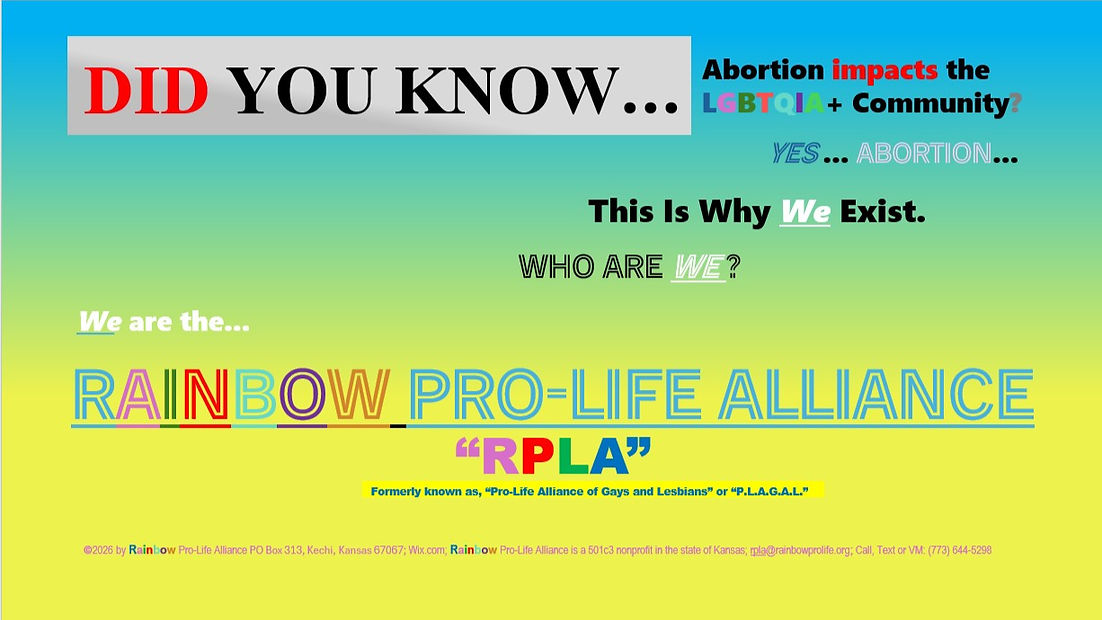
Questioning, Contemplating, Having or Had an Abortion? Blasé, Concerned or Terrified of Traditional Pro-Lifers? Let's Talk.
You Thought Coming Out To Family As LGBT+ Was Difficult Try Coming Out To Friends As Pro-Life. We're here to help!

HUMAN RIGHTS START WHEN HUMAN LIFE BEGINS
June Zoom Meeting
Join us Thursday June 18th @ 8pm Eastern/5pm Pacific as our guest speaker, Lauren Pope, Executive Director of Rehumanize International presents:
Rehumanize Yourself.
Join our email list below for link
May Zoom Recording
Dr. Lile gave a detailed and intriguing case illustrating that the Pre-Born are being effectively treated for numerous aliments in utero because they are patients. Patients deserve health care and equal protection.
Check out Jason & Chastity's Missouri Amendment chat: https://youtu.be/nDf5ixracPQ
More Alt Pro-Life orgs & activities:
https://www.horrorandhope.com/
https://www.rehumanizeintl.org/events
https://rescueresurrection.com/
https://jewishprolifefoundation.org/
"Many decisions to preemptively remove an unborn child are related to factors external to the child themselves. Pressures from partners, parents, finances and futures are real. Yet our democracy challenges us to be thoroughly inclusive, certainly beyond what may serve ourselves expedient. The violent eviction of the innocent human in utero is inhumane, unjust and unnecessary.
The preborn child is subject to a plethora of prejudices based on sex, race, ability, anomaly, gestation and location. We've oft stated that genetic tests could lead to the prenatal extermination of LGBTQIA+ persons. For intersexed individuals that time has already arrived.
This Rainbow Community would be remiss not to mention that none other than Judy Garland, Cher, Oprah and Celine Dion were nearly aborted.
No matter who you are or where you are or why, your life should matter. Human discrimination and abuse can start as early as fertilization so civil rights and bodily integrity protections must as well"
Jason Dean, President Rainbow Pro-Life Alliance
We are often asked to provide answers for students who are doing research. Below is a recent Q & A
1. Can you briefly describe your role, organization or connection to reproductive rights issues?
The Rainbow Pro-Life Alliance is primarily focused on bodily integrity of the preborn and their parents. Reproductive rights is an element of bodily integrity yet does not supersede it. Reproductive rights pertain to everyone with reproductive organs which begin to emerge 4 to 5 weeks post-fertilization.
2. What changes have you observed since the overturning of Rove v. Wade?
An escalation in the conflation of terms "reproductive rights" and "health care" with abortion. Crushing an offspring's skull at 12 weeks post-reproduction is the antithesis of "health" or "care". Treating human beings as property is not a 'right' we recognize.
3. Who do you believe has been most affected by recent reproductive rights policies, and how?
The pre-born have been most affected by policies that explicitly ignore their bodily integrity rights.
4. What role should state governments play in regulating reproductive healthcare compared to the federal government?
All levels of government should be committed to protecting the bodily integrity of all human beings regardless of location, anomaly, race, gender, age or ability.
5. What state-level policies have most affected your work? How have organizations adapted to increasingly different state laws?
An increasing divergent pattern has emerged where some states are expanding human rights in utero while others are drastically shrinking them.
6. What do you believe is the biggest misconception the public has about reproductive rights and abortion policy?
The biggest misconception is that abortion is a 'reproductive right'. Conception is the effectuation of a reproductive right. Once one is pregnant they are literally 'with child' and a balance of rights between the pre-born and their parents ensues under a regime consistent with equal protection.
7. What do you see as the most significant barriers facing people affected by reproductive healthcare laws today?
The most significant barriers are the denying of healthcare access to preborn children.
8. Do religion, morality, or personal values play in shaping opinions on reproductive rights? What motivates your organization work?
We are motivated by science and love to expand human rights. Morality and religion are being used to inflict violence, discrimination and death on the most vulnerable in our society, including those in the LGBTQIA+ and preborn communities.
9. What policy changes or actions do you believe would improve the current situation?
Amplifying the 8,000 voices of those who have survived an abortion process.
10. What perspectives or voices do you think are currently missing from public discussions?
Well, there's about 63 million voices missing because they were aborted.
11. How do people typically misunderstand your position? Which arguments are the hardest to respond to?
There are many contrived circumstances meant to confuse by conflating miscarriage care and labor induction with elective abortion. There are several circumstances where a child may need to be removed via medication or preterm delivery. Introducing additional steps to ensure fetal demise via starvation, dismemberment or poison is unjust, unnecessary and does nothing to improve the pregnant person's health.
12. What arguments or messaging strategies have proven most effective with the public?
Expose the violence of abortion.
13. How does your organization engage with communities or individuals facing unexpected pregnancies? What services or support do you provide beyond advocacy?
We conduct monthly virtual meetings to support individuals grappling with issues surrounding pregnancy. We offer a heightened awareness and care to non-hetrosexual persons who are pregnant.
14. What outcomes would you consider a success for your movement?
A society where acts of violence, like abortion are not tolerated.
Chastity's Pride Month Message:
SALUTE THE RAINBOW FLAG
The most potent weapon against the lesbian and gay community has been
the stereotypes that we have ourselves aided in creating. Our parades
are videotaped, but only our campiest brethren are not edited out; our
statements are recorded, but only the most extreme are heard; our
disagreements are noted, but only the most politically correct are not
filtered out. We find ourselves portrayed as an army of leather and
feather clad politically correct hot-heads marching in lockstep (in
heels??) to the beat of the same drummer.
And yet, when any group raises its head, not to denounce our more
eccentrically coffered siblings, but to disagree with the community's
self appointed coat-and-tie leadership, we are ostracized.
It is not too much to say that there is a concerted effort within the
gay and lesbian community to suppress the pro-life message. If you
come forth as a pro-life gay man or lesbian, you are likely to be
accused of sedition. To speak in defense of the unborn is to violate
the last taboo of the gay community. The argument that sexual privacy
rights necessarily are dependent on abortion rights is specious. In
the 1973 the Supreme Court ruled that abortion was a constitutionally
protected privacy right: In 1986 the Supreme Court ruled that
consensual homosexual relations were not. Therefore, for lesbians and
gays this specific constitutional theory of privacy rights is
irrelevant.
When was the last time that the Human Rights Campaign Fund or any
local gay political action committees endorsed a pro-life candidate
for office -- even if that candidate was also pro gay? And what about
the routine diversion of funds raised by AIDS walks to abortion
providers -- and this in the name of compassion for people with with
AIDS? Pro-life gays and to lesbians -- even those who have lost loved
ones to AIDS -- have actually found themselves excluded from AIDS walks
because they objected to this practice. When any march or rally is
proposed to seek redress of a grievance of the lesbian and gay
community -- anti-gay violence, for example -- it must be joined in
equal measure with a demand for reproductive freedom and abortion on
demand. We are exhorted in our publications and e-mail to resist any
restriction on abortion as if it intended to replace the daily
execution of 4400 of the unborn with 4400 of our own.
Of all Americans, those of us in the sexual minority community have
the most reason to be concerned about protecting human life. After
all, we know what it is to have our lives and rights trampled on,
especially the basic human right just to keep on living. Homophobia
has placed our right to life in danger every day: ask anyone who has
been bashed or someone whose insurance will not cover lifesaving
medical care. We fight back in every way that we can: we organize, we
lobby, we vote. We claim the same basic rights heterosexuals take for
granted.
But lesbian and gay Americans are not the only ones whose rights are
jeopardized. Everyday, the ugly face of prejudice shows itself when
the rights of others are shortchanged because of gender, race, state
of health, ethnicity, religion, politics, etc. The gay community has
come to the realization that we cannot work for our own rights alone
but must work to achieve basic human rights for all those who suffer
discrimination.
Why? Because our rights and the rights of others are the same human
rights. As gay men and lesbian women, we stay that all human life
deserves dignity and respect. No human life should be considered
expendable and the basic right to live should be guaranteed without
threat or harassment. That includes the unborn, a voiceless minority
with no defense against the worst of all abuses: death. Some 4400 are
wiped out every day. Why must we speak for unborn people? Simply
because they are people. To be pro-life and pro-gay is to affirm that
human rights are not discretionary.
America's abortion policy violates this basic concept of human rights.
Just like homophobia, abortion denies people their status as members
of human society. Just like homophobia, abortion tries to rid society
of real human beings who are considered threatening or undesirable.
Just like homophobia, abortion denies one's place as a member of human
society and even one's right to be alive in it.
No, not all lesbians and gays are "pro-choice" and it is far past the
time when the stereotype imposed on us by some of the "leaders" of our
community attempt to force upon us is removed. No survey suggests that
members of the sexual minority community are any more pro-choice than
the average American. While equal rights have not yet been won, we
have grown into a community as diverse as the nation. Closet doors
have been abandoned by the thousands. Invisibility and fear are fading
into history. Gays and lesbians come from many different backgrounds
and hold widely differing belief on many issues. We represent a
diversity and pluralism of beliefs at which the rainbow flag only
hints. To attempt to enforce a "party line" on all members of our
community is to betray the very cause we are fighting for: The right
to be different.
For years, mainstream society has rightly been condemned for not
letting lesbians and gays participate fully in the American dream. Now
we, in turn, are not permitting our own to be fully active in gay
society. We wave rainbow flags and envision multi-colored mosaics but
somehow these colors fade away when gay pro-lifers attempt to join the
parade. Gays and lesbians who tout ideological diversity prove
themselves hypocrites when they ostracize gay pro-lifers.
If the gay movement is to win the struggle against bigotry and
intolerance in mainstream American society, it must first eliminate
bigotry and intolerance within it own ranks. We must not do the work
of homophobes for them by stereotyping ourselves and enforcing a
blanket of political correctness. Even worse, they hinder our entire
march of civil rights. When gays and lesbians stereotype themselves
with a uniform of political correctness, we make it easy for anti-gay
fanatics to smear all of us.
The existence of the Pro-Life Alliance of Gays and Lesbians (PLAGAL)
shreds both the stereotype which the lesbian and gay community has of
pro-lifers as well as the stereotype which the straight community has
of lesbian and gay Americans. The voices of lesbian and gay pro-lifers
are testimony that gays and lesbians are, indeed, everywhere.
Twenty-five years ago others fought for our rights at Stonewall and we
can best honor their memory by defending the rights of others today.
Not only the rights of unborn Americans, but also the free speech
rights of gay and lesbian Americans. After all, the fight at Stonewall
was for our right to be different, not merely to replace the
conformity demands of straight society with the conformity demands of
certain elements of gay and lesbian society. The freedom of gays and
lesbians -- not the extermination of the unborn -- must be the
benchmark for gay liberation.
Abortion proponents have targeted the LGBТ community with a position
paper to the effect that our rights are dependent on the judicially
created "right to privacy" which is the foundation upon which Roe v.
Wade, and hence abortion, is based. The parallel analysis of changes
in abortion rights with changes in gay rights shows how specious this
argument is.
Since the Roe v. Wade decision of 1973, there has been a slow and
consistent erosion of abortion-on-demand with the imposition of
mandatory counseling, waiting periods, and parental notification.
Prohibitions against the expenditure of federal funds as well as state
funds have been found constitutional. International family agencies
receiving U.S. aid have been prevented from counseling for abortion.
Casey v. Planned Parenthood replaced Roe v. Wade as the law of the
land on abortion; it replaced the "strict scrutiny" test of state
anti-abortion laws with a much weaker "undue burden" test, with four
of the nine justices calling for an outright reversal of Roe.
Thirty-two states now require parental notification and 18 states
require waiting periods and counseling as to risks and fetal
development. Both houses of Congress have voted to ban "partial birth"
abortions. And the number of abortions has been steadily declining for
at least a decade. The recent uptick in mailed abortion pills is harder to access as stockpiling and mind changing increase uncertainty in the numbers.
As abortion rights have been undergoing a consistent cutback, there
has been a simultaneous expansion of gay rights. In 1961, all states
and the District of Columbia had anti-sodomy laws. By the time of the
infamous Bowers v Hardwick decision in 1976, fully 50% of the states
had already decriminalized sodomy. Bowers held anti-sodomy laws
constitutional and stated that the fact that homosexual conduct occurs
in the privacy of the home does not affect the result. Bowers was
decided fully three years after Roe v. Wade, giving lie to the
argument that the "right to privacy" had any application to the LGBT
community: "Respondent would have us announce …a fundamental right to
engage in homosexual sodomy. This we are quite unwilling to do."
This is the same court, which by a 7 to 2 holding, found a fundamental
right in the abortion process.
When Bowers was specifically overruled by Lawrence v. Texas in 2003,
the 25 states that had outlawed sodomy in Bowers had been reduced to
only 13, of which only 4 enforced their laws against homosexual
conduct. In dissent, Justice Scalia noted that the LGBT community had
had considerable success in promoting their agenda to decriminalize
sodomy through democratic means. To be sure, there is plenty of
language in Lawrence as to "privacy," but it has little, if any,
relevancy to the actual holding based on the due process clause of the
14th Amendment.
Gay marriage (civil unions, domestic partnerships) is currently a hot
public policy issue, but it is the very antithesis of a privacy right
because it seeks state action for the approval and sanction of LGBT
relationships. Because the marriage contract is a three-party contract
(the state is the third party) there can be no meaningful talk of a
"right to privacy." The issue of marital equality is one which has
just started, with a few states taking positive steps and The several
states taking negative ones. The LGBT community need not fear the
competition in the marketplace of ideas.
Other than gay marriage (which does not concern the right to privacy)
and sodomy (which has been won largely by the democratic process and
not litigation) the Supreme Court's only other gay decision, Romer v.
Evans, is based on equal protection of the laws and not the right to
privacy. Romer disallowed a Colorado constitutional amendment which
would have denied gays the protection of anti-discrimination laws. The
argument for the right to privacy (“get out of my bedroom") is an
appealing one for the LGBT community but it has nothing to do with the
advancement of gay rights since the movement began with the Stonewall
Riots of 1964. The long fight to decriminalize gay sexual behavior was
won state by state through the democratic process. The success was so
absolute prior to the Lawrence decision that homosexual sodomy was
outlawed in only 4 of the 50 states, and even in those states it was
not enforced, leading Justice Thomas to call it an "uncommonly silly"
law. The fight for marriage equality is a public policy issue outside
any privacy concerns. Any other gay court decision has addressed equal
protection of the laws, once again not sounding in any "right to
privacy."
The position paper put forth by abortion advocates is a thinly veiled
attempt to shore up rapidly fading support for abortion-on-demand. Gay
Americans, much like their counterparts in straight America, have
differing philosophical, religious, moral, ethical, and pragmatic
attitudes toward abortion. This appeal to our self-interest will fail
as will the attempt to divide and conquer. Abortion advocates have
attempted to divide men from women, rich from poor, white from black,
religious from secular but it appears all this hard work will come to
naught. Abortion rights will fail because, unlike gay rights, they are
not the result of a democratic process but rather a brand new
"constitutional right" created by a court impatient with democratic
change
MONTHLY MEETINGS
Watch Recording - February RPLA Zoom Meeting with Randall Terry, Ban The Abortion Pill!:
Catch Music Video Here:
https://youtu.be/Po9IiMinilE?si=z7q45gwn86L0-R3r
David McClamrock, Editor of Solid for America Magazine, led our December talk on: "Seeking to Bind Up the Nation's Wounds" Here's the recording:
https://youtu.be/chVQ9XVJXXY
To read Solid for America interview with RPLA click here:
https://solidforamerica.com/2025/11/07/issue-2-november-2025/
To review our November meeting with our guest, Cecily Routman, Founder and President of the Jewish Pro-Life Foundation please visit here:

GET INVOLVED


MAKE A DONATION
VISIT OUR ZAZZLE
MERCH STORE
https://www.zazzle.com/s/rainbow_prolife
SPEAKERS
If you are looking for a speaker for your next conference, panel discussion, debate or college pro-life meeting, RPLA has several individuals available as speakers. For more details and/or to schedule a speaker, please contact us.
VOLUNTEER YOUR TIME
The Rainbow Pro-Life Alliance is seeking additional leaders who want to help advance our life-affirming mission.
Are you pro-life AND a member of the LGBTQ+ community (or a supportive ally)?
Ending the tragedy of abortion in our country requires a broad coalition. We believe the pro-life movement should welcome supporters regardless of age, race, religion, and yes– sexual orientation and gender identity. Do you want to help us build a more inclusive pro-life movement? Do you want to expand the reach of the pro-life movement?
YOU can participate in this important effort by becoming an active board member of Rainbow Pro-Life Alliance. We are currently accepting applications for new board members!
Board membership is open to LGBTQIA+ individuals and allies. The Rainbow Pro-Life Alliance board is a working group, not an advisory committee. Requirements to join include a commitment to attend a one hour monthly business meeting which is held virtually over Zoom as well as an additional 1 to 3 hours participating at our monthly general meeting and/or working on specific events or tasks. Serving on the board of Rainbow Pro-Life Alliance is an unpaid, volunteer position. Before applying, one should evaluate whether or not they can realistically commit the time that the role requires.
We each have unique gifts and talents that we can bring to life. We want to give you opportunities to utilize them in support of Rainbow Pro-Life Alliance’s pro-life educational and activist work. Based on your individual skills and experience, your contributions could include creating social media content, updating our website, event planning, research, communications, accounting, representing the organization at events, fundraising, creative design and philosophy, and more.
To apply to be a RPLA Board Member: rpla@rainbowprolife.org
Include a bio. detailing your experience and abilities.
Applications accepted on a rolling basis.
Please note that Rainbow Pro-Life Alliance is a registered 501(c)(3) nonprofit organization. We do not endorse or support candidates for public office. We are not affiliated with any political party or religious denomination. We are nonpartisan and non-sectarian with a single-issue focus: abortion. We do not address issues such as the death penalty, international affairs, contraception, immigration, animal rights, taxation, government spending, the environment, voter ID, or any other issues except where they directly intersect with the issue of abortion. Our board and general membership includes Republicans and Democrats, conservatives and progressives, moderates, independents, libertarians, and others. Individuals of all political stripes are welcome to join us in the fight against abortion.
If you have any questions or need more information, please email Jason Dean, president of Rainbow Pro-Life Alliance: rpla@rainbowprolife.org

